
 Facebook
 X
X
 Pinterest
 Copy Link
I’m sure if you’ve ever watched one of those home-buying shows, you’ve probably heard someone say:
“I want character.”
“I love older homes.”
“I don’t want one of those cookie-cutter houses.”
As a Realtor, I hear it all the time.
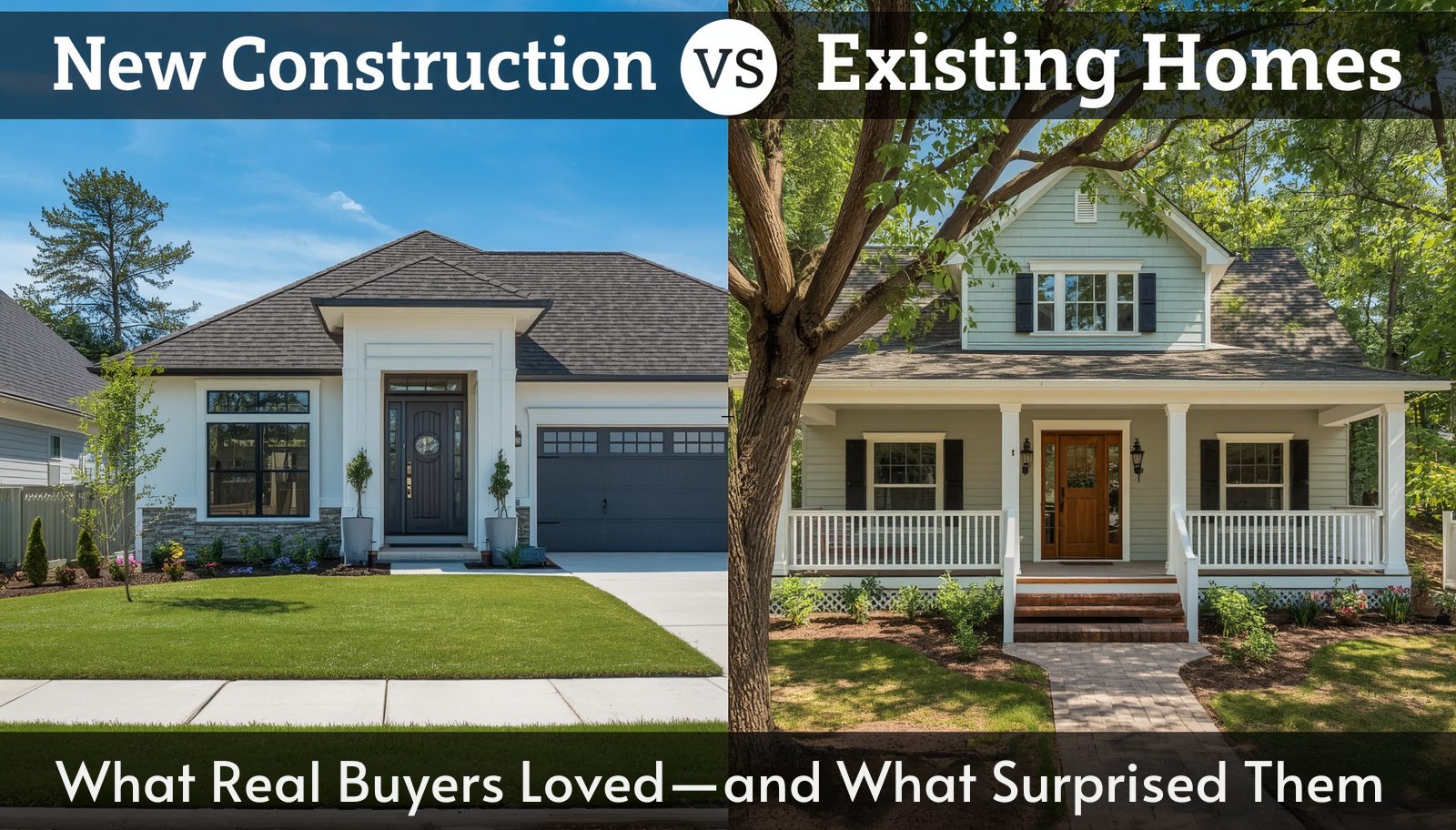
The debate between new construction and existing homes is one of the most common decisions buyers face during their home search.
Then we start touring homes.
After a few houses with aging roofs, outdated kitchens, tiny closets, and a growing list of future projects, many buyers suddenly become a lot more interested in that shiny new construction community they swore they weren’t going to consider.
Of course, the opposite happens too. I’ve worked with buyers who were convinced they wanted brand-new construction until they discovered a beautifully updated home in an established neighborhood with mature trees, a larger lot, and more character than they thought possible.
Over the years, I’ve learned that the home many buyers ultimately choose is often different from the one they imagined when they started their search.
Let’s look at the three most common paths I see buyers explore—and what often surprises them along the way.
Path #1: Brand-New Construction
There is something undeniably appealing about being the first person to live in a home.
No mystery paint colors.
No questionable DIY projects.
No wondering why someone installed a ceiling fan that looks like it belongs in a restaurant.
Everything is brand new.
For many buyers, especially first-time buyers, new construction offers a level of simplicity and peace of mind that’s hard to ignore.
What Buyers Love
Modern builders have become very good at designing homes for the way people live today.
Open floor plans, larger kitchens, walk-in pantries, spacious closets, home offices, and energy-efficient features are all things buyers commonly tell me they’re looking for.
Then there’s the model home.
Let’s be honest—that model home is doing some heavy lifting.
The bright kitchen, spa-like bathrooms, oversized island, and perfectly staged furniture have changed more than a few buyers’ minds over the years.
Many new construction communities also offer amenities that can be difficult to find elsewhere, such as community pools, fitness centers, playgrounds, walking trails, and clubhouses.
And let’s not forget one of the biggest factors in today’s market: builder incentives.
As of 2026, many builders continue to offer incentives such as closing cost assistance, interest rate buydowns, design center credits, first-year HOA credits, or other promotions designed to help buyers afford a home.
For some buyers, especially first-time buyers, these incentives can be the difference between buying a home now and waiting another year. For others, they may create opportunities to purchase a larger home or enjoy features that might have otherwise been outside their budget.
I’ve worked with buyers who initially preferred an existing home but ultimately chose new construction because the builder’s incentives made the overall financial picture more attractive.
What Buyers Are Often Surprised to Learn
One of the biggest surprises buyers encounter is that “brand new” doesn’t always mean “fully finished.”
Depending on the builder and price point, items many buyers assume are included may actually be additional expenses.
Features such as:
- Refrigerators
- Washers and dryers
- Gutters
- Window blinds or shades
- Fencing
- Landscaping upgrades
may not be included in the base price of the home.
One thing buyers quickly discover is that what comes standard with one builder may be considered an upgrade—or not offered at all—by another.
For example, Builder A may advertise a lower starting price, while Builder B includes features such as gutters, blinds, appliances, fencing, or other upgrades that would cost thousands to add later.
That’s why it’s important to look beyond the base price and compare the complete package. Sometimes the builder that initially appears more expensive ends up being the better value once all the numbers are on the table.
The model home can also create unrealistic expectations, though not for the reasons some buyers might think.
Builders typically use model homes to showcase the possibilities available within a community. The gourmet kitchen, upgraded cabinetry, premium countertops, designer lighting, and top-tier flooring selections are often intended to demonstrate what buyers can choose if they’re building from the beginning.
That doesn’t mean the standard features aren’t attractive or that anyone is trying to create a bait-and-switch situation. In fact, many builders offer very nice standard finishes. The key is simply understanding which features are included in the advertised price and which features represent optional upgrades.
Buyers are sometimes surprised to learn that their favorite lot may carry a premium, or that the wooded view they love comes with an additional cost.
Another surprise? Mailboxes.
In many newer communities, mail is delivered to centralized mailbox stations rather than individual mailboxes at the end of each driveway. It’s not necessarily a negative—it’s just something buyers don’t always expect.
Construction timelines can be another surprise. If you’re building from the ground up, weather delays, material availability, labor shortages, and permitting can all affect the timeline.
Timelines can also vary significantly from one builder to another. I’ve worked with builders who routinely complete homes in four to five months, while others may take nine months or longer depending on the community, level of customization, price point, weather conditions, and availability of materials.
And yes, even brand-new homes should be inspected.
New doesn’t automatically mean perfect. In fact, most builders expect buyers to conduct inspections and have established procedures for scheduling them. A professional inspection can help identify issues before closing and provide additional peace of mind.
Many buyers are surprised to learn that new construction inspections are common and considered a normal part of the process.
For many buyers, new construction is exactly the right fit. The key is understanding both the advantages and the realities so you can decide whether it’s the best fit for your lifestyle, priorities, and budget.
Path #2: The Best-of-Both-Worlds Home
This is where many buyers end up.
These are often homes that are only 3 to 10 years old and still feel fresh, modern, and move-in ready.
In fact, many buyers who begin their search focused exclusively on new construction are surprised to discover that a 5- or 10-year-old home may check nearly every box on their wish list.
The floor plan still feels current.
The kitchen is still beautiful.
The closets are still spacious.
The home may even look remarkably similar to homes being built today. In some communities, the builder may still be building the very same floor plans in a newer phase of the neighborhood.
The difference is that someone else has already lived there long enough to finish the things many buyers don’t think about when they’re touring model homes.
What Buyers Love
One of the biggest advantages of a nearly-new home is that many of the improvements have already been completed.
The fence is already there.
The blinds are already installed.
The landscaping has had time to mature.
The patio may already be extended.
The screened porch may already be built.
The garage may already have storage systems.
The lighting may already have been upgraded.
Sometimes those improvements go far beyond fences and blinds.
Depending on the property, buyers may find swimming pools, gazebos, workshops, greenhouses, garden spaces, outdoor kitchens, or other enhancements that would cost tens of thousands of dollars to recreate today.
For some buyers, being able to purchase a home with those features already in place can be a significant advantage.
These are improvements that can add up to thousands—or even tens of thousands—of dollars if purchased separately.
Another advantage is that what you see is what you get.
When you’re touring a nearly-new home, you’re looking at the actual home, actual lot, actual backyard, and actual view. You don’t have to imagine what it will look like once construction is complete or landscaping has had a few years to grow.
Many buyers also appreciate that the neighborhood has had time to settle in. The amenities are typically complete, the roads are finished, and the community has developed its own personality.
Another benefit buyers don’t always consider is that the home has had time to settle in.
The first-year adjustments that commonly occur in new homes—things like nail pops, minor settlement cracks, and warranty punch-list items—have often already been addressed. In many cases, the original owners have already worked through those early issues, leaving the next owner with a home that has had many of the initial kinks worked out.
What Buyers Are Often Surprised to Learn
One of the biggest surprises is how little difference there can be between a nearly-new home and a brand-new one.
Buyers sometimes assume that anything other than new construction will feel dated. Then they walk into a well-maintained home built five or ten years ago and realize it offers many of the same features they admired in new construction communities.
Another surprise is how competitive a nearly-new home can be when compared side-by-side with new construction.
Buyers may find themselves comparing two homes with similar square footage and similar prices, only to discover that the existing home already includes improvements that would cost significant money to add later. Fences, blinds, gutters, mature landscaping, screened porches, pools, workshops, and outdoor living spaces can represent substantial value that isn’t always obvious at first glance.
In some cases, buyers are surprised to discover that the existing home isn’t just comparable to the new construction option—it may actually offer more for a similar overall investment.
Buyers are often surprised by how much uncertainty has already been removed. You’re not wondering what the backyard will look like in a few years, whether the community amenities will be completed, or what future phases of the neighborhood might bring. You can experience the home and the community exactly as they exist today.
Of course, nearly-new homes don’t always come with the same builder incentives that attract buyers to new construction. However, buyers may be able to negotiate a one-year home warranty as part of their offer. While it’s not the same as a builder warranty, it can provide additional peace of mind during that
first year of ownership.
That’s why it’s important to look at the complete picture rather than focusing on a single feature or incentive.
The goal isn’t simply to find the newest home. It’s to find the home that offers the best overall value for your needs, lifestyle, and budget.
For many buyers, a nearly-new home strikes that balance beautifully.
Path #3: Character and Charm
For some buyers, no amount of granite countertops, builder incentives, or community amenities can compete with the feeling they get when they walk into a home full of character.
These are the buyers who notice the original hardwood floors.
The detailed trim work.
The built-ins.
The mature oak trees.
The front porch that practically begs for a rocking chair and a glass of sweet tea.
They aren’t necessarily looking for the newest home.
They’re looking for a home with personality.
And sometimes, that’s exactly what they find.
What Buyers Love
One of the biggest advantages of established homes is that many are located in neighborhoods that have had years—or even decades—to mature.
The trees are larger.
The landscaping is established.
The streets often feel more settled and inviting.
Depending on where you’re looking, you may also find larger lots, more distance between homes, or the convenience of being closer to shopping, restaurants, employers, and the places you visit most often.
Many older homes also offer architectural details that can be difficult to find in newer construction. From historic cottages to mid-century ranches and custom-built homes, established neighborhoods often provide more variety and individuality than newer communities.
Perhaps the biggest surprise of all is that not every older home is a project.
Many have been thoughtfully updated over the years with modern kitchens, renovated bathrooms, updated systems, and improved energy efficiency while still preserving the character that attracted buyers in the first place.
For some buyers, that combination of charm and modern convenience feels like the best of both worlds.
What Buyers Are Often Surprised to Learn
Character can come with quirks.
The floor may not be perfectly level.
The closet may not be enormous.
The laundry room may not be exactly where you would put it if you were designing the house today.
And sometimes the home has a few stories to tell.
Of course, not every quirk is a drawback.
In fact, for many buyers, the quirks are part of the appeal.
A slightly crooked doorway in a century-old home, an unexpected reading nook, original built-ins, or even a hidden pass-through between closets can become some of the most memorable features in a home.
The key is understanding the difference between character and condition. A charming architectural detail is very different from a structural issue, and many buyers are delighted to discover that the unique features they once worried about are the very things that make them fall in love with a home.
Buyers are also often surprised to learn that maintenance expectations can be different. Depending on the age and condition of the home, there may be older systems, unique materials, or repairs that require a little more attention than a newer property.
Insurance can also be a consideration in some situations. Before falling in love with any home, it’s wise to obtain insurance quotes early in the process so there are no surprises later.
In fact, some of the most desirable homes I show are established homes that have been lovingly maintained and thoughtfully updated over time.
New Construction vs Existing Homes: Which One Is Right for You?
The truth is, there isn’t a single right answer.
I’ve worked with buyers who were happiest in brand-new construction communities, buyers who fell in love with nearly-new homes, and buyers who couldn’t imagine living anywhere except an established neighborhood full of character.
One thing I’ve learned over the years is that buying a home is often an evolution. As buyers tour homes and compare options, they frequently learn more about themselves—and occasionally discover a few surprises about each other along the way—than they ever expected.
Sometimes the process isn’t just about finding the right house. It’s about figuring out which features truly matter and which ones don’t. I’ve worked with buyers who started out wanting completely different things, only to discover that they agreed on more than they realized once they focused on how they wanted to live rather than simply what they thought they wanted in a house.
I’ve worked with buyers who were convinced they wanted one type of home, only to fall in love with something completely different once they could truly picture themselves living there. Sometimes the best fit isn’t the option you started with—it’s the one you discover along the way.
Over the years, I’ve found that the most successful buyers eventually stop focusing solely on the house and start focusing on how they want to live. That’s often when the right home becomes much easier to recognize.
The goal isn’t to find the best type of home.
The goal is to find the home that best fits your priorities, lifestyle, and budget.
Ask questions.
Challenge your assumptions.
Keep an open mind.
You may be surprised where your search ultimately leads you—and that’s perfectly okay.
— Sharie McCormack
Service you deserve. People you trust.
Explore homes currently available in the Savannah area using the property search feature on my website.
Looking for more real estate insights? You may also enjoy my article, Home Pricing Mistakes Sellers Should Avoid.


